


Do You Actually Need a Hardwood Floor Nailer? (DIY Truth in 2026)
Do you need a hardwood floor nailer? Learn when a flooring nailer is required, when you can skip it, and how floating hardwood systems can save DIYers time and money.

You've picked your hardwood. You've prepped your subfloor. And now someone at the hardware store tells you to rent a hardwood floor nailer for the weekend. Fifty to eighty dollars a day, plus a compressor, plus hoses. Three to four hundred dollars by the time the project's done. You nod and pull out your wallet because, well, that's just what you do.
Stop. Because that assumption costs a lot of DIYers real money for a tool they don't actually need.
Here's the honest breakdown: a hardwood floor nailer is only mandatory for one specific installation scenario. For every other scenario, you have options that are cheaper, faster, and frankly easier for most homeowners to pull off on a Saturday. I've seen people rent a $400 nailer setup for a project that required zero nails. I've also seen people skip the nailer and end up with a floor that performs beautifully for decades. The difference came down to knowing which installation method matched their floor and subfloor.
This guide cuts through the noise so you can make the right call before you spend a dime on tools.
TL;DR
- You only need a hardwood floor nailer for traditional tongue-and-groove solid hardwood installations.
- Click-lock and clip-based systems require zero nails and zero rental fees.
- Renting a nailer runs $50–80/day; buying one costs $300–600. Neither is necessary for modern floating systems.
- Most DIYers installing solid hardwood today are better served by a floating system than a nailer.
- If your flooring method requires a nailer, make sure your subfloor is nail-friendly; concrete slabs are not.
What Is a Hardwood Floor Nailer?
A hardwood floor nailer (also called a flooring nailer or flooring stapler) is a pneumatic tool that drives cleats or staples at a precise 45-degree angle through the tongue of a hardwood plank and into the subfloor below. You position the tool against each board, strike the plunger with a rubber mallet, and the fastener is driven in and hidden by the next row. It requires an air compressor, a hose, and usually a separate compressor rental on top of the nailer itself.
You need a hardwood floor nailer ONLY if installing traditional tongue-and-groove solid hardwood using the nail-down method over a plywood or OSB subfloor. Click-lock and clip-based floating systems require zero nails and no pneumatic tools of any kind.
That distinction changes everything for a DIYer planning a project. The NWFA (National Wood Flooring Association) installation guidelines recognize three primary hardwood installation methods: nail-down, glue-down, and floating. Only nail-down requires a flooring nailer. The other two methods have no pneumatic tool requirement at all.
The tool itself runs $170 to $690 to purchase new, depending on brand and gauge, according to listings at Nail Gun Depot. Entry-level pneumatic models like the Husky 3-in-1 come in around $169 at Home Depot. Professional-grade units from Powernail or Bostitch climb to $550 and beyond. For a single DIY project, buying outright makes little financial sense unless you plan to install floors in multiple homes.

When You Actually Need a Hardwood Floor Nailer
There's one scenario where a hardwood floor nailer is genuinely the right tool: you're installing 3/4-inch solid tongue-and-groove hardwood over a wood subfloor (plywood or OSB, at least 3/4-inch thick), and you want a nail-down installation.
This is the traditional method. According to This Old House's hardwood floor installation guide, a pneumatic flooring nailer is "optional but recommended" for most of the installation, with fasteners driven every 6 to 8 inches along each board. The nail-down method produces an exceptionally stable floor, particularly for wide planks (5 inches or wider) where the mechanical connection to the subfloor prevents cupping and gapping over time.
There are also a few other situations where nail-down makes sense even if it's not strictly "required." If you're working in a very humid climate, nail-down provides more dimensional stability for wide planks. And if you want the absolute firmest, most solid-underfoot feel with no hollow sound, nail-down achieves that.
But notice the word "plywood subfloor." Nail-down does not work over concrete slabs. If your project is in a basement, a slab-on-grade living area, or anywhere concrete is the base layer, a nailer is off the table anyway, regardless of how much you might want to use one.
Installation Method vs. Hardwood Floor Nailer: Do You Need One?
| Installation Method | Flooring Type | Subfloor | Nailer Required? |
|---|---|---|---|
| Nail-down (traditional) | 3/4" solid tongue-and-groove | Plywood / OSB | Yes |
| Glue-down | Solid or engineered hardwood | Concrete or plywood | No |
| Click-lock floating | Engineered or click-lock solid | Any flat surface | No |
| Clip-based floating | Solid hardwood with clip groove | Any flat surface | No |
| Hand-nail (manual) | 3/4" solid tongue-and-groove | Plywood / OSB | No (but slow) |
When You Don't Need a Hardwood Floor Nailer
Here's where I want to save you real money. The majority of DIY hardwood projects in 2026 do not require a flooring nailer. That's not a technicality or a workaround. It's a product-driven reality: the flooring market has evolved significantly, and most modern systems are designed specifically to eliminate the tool barrier for homeowners.
Three installation approaches bypass the nailer entirely.
Click-Lock Floating Systems
Click-lock hardwood planks feature specially engineered tongue-and-groove edges that snap together horizontally. No adhesive. No fasteners. No compressor. The planks interlock, and the assembled floor floats as a unified surface over a foam or cork underlayment. I've watched a first-time installer get two rooms done in a single afternoon this way.
For a full breakdown of what click-lock solid oak means for DIYers, see our guide to click-lock solid oak flooring for DIYers.

Clip-Based Floating Systems
Clip-based systems, like the Easiklip approach, take the floating concept a step further. Metal or plastic clips sit in a routed groove on the underside of each plank and snap onto a track or the preceding row. The installation is fully mechanical and completely reversible. No adhesive, no pneumatic tools, no nails. The floor can be disassembled and relocated if you move or remodel.
This method works on concrete, plywood, OSB, tile, and even existing hardwood, as long as the surface is flat. That means it works in basements, condos, and ground-floor slabs where nail-down is impossible. For a complete rundown of what floating solid hardwood installation involves, the complete guide to floating solid hardwood flooring covers every detail.
Glue-Down
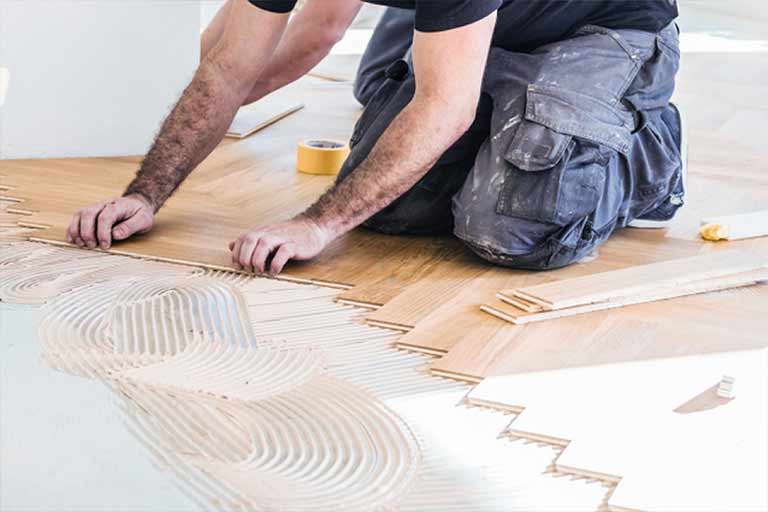
Glue-down involves no nailer either, though it trades one complexity for another. You're applying urethane adhesive with a notched trowel over the entire subfloor surface and pressing planks into it. The adhesive runs $3 to $5 per square foot, and you're working against a 30 to 45-minute open time per spread. For a 200-square-foot room, that's $600 to $1,000 in adhesive alone, on top of the application challenge. I don't recommend it for most DIYers. The floating options are cleaner, faster, and reversible.
The cost advantage of skipping the nailer is concrete. On a 500-square-foot project, choosing a clip or click-lock floating system instead of nail-down can save $400 to $600 in tool costs alone, before you factor in the time and learning curve of operating pneumatic equipment.

Buying vs. Renting vs. Skipping the Hardwood Floor Nailer Entirely
Let's get to the numbers. This is what a DIYer actually faces across the three tool scenarios for a standard 500-square-foot project.
| Scenario | Tool Cost | Additional Equipment | Total Tool Outlay | Reusable? |
|---|---|---|---|---|
| Buy a nailer (entry-level) | $170–$299 | Air compressor ($120–$200), hose, fittings | $290–$500+ | Yes, if you install again |
| Buy a nailer (pro-grade) | $400–$690 | Air compressor, hose, fittings | $520–$890+ | Yes |
| Rent a nailer (2-day weekend) | $50–$80/day | Compressor package adds $45–$115/day | $190–$390 for weekend | No |
| Clip or click-lock system | $0 nailer cost | Rubber mallet, pull bar, tapping block (~$30) | $0–$30 | Yes |
Rental prices sourced from CountBricks 2026 floor nailer rental rate data; purchase prices reflect current listings at major tool retailers. The nailer package rental (nailer plus compressor plus fittings) is the honest all-in number most DIYers face, not just the nailer tool in isolation.
For a single DIY project, renting beats buying unless you're installing floors in multiple rooms or multiple properties. But skipping the nailer entirely, by choosing a floating installation, beats both options. You're looking at $160 to $360 in savings on a modest weekend project.

What Professional Installers Actually Use in 2026
Something has shifted in the flooring industry over the past five years, and I think it matters for how you approach your project. Professional installers increasingly specify floating and clip-based systems, not just because they're easier, but because the performance has closed the gap with nail-down in most residential applications.
Here's what I know from watching this industry: the resistance to floating solid hardwood used to be legitimate. Early floating systems used laminate or thin engineered cores that didn't perform like real wood. That's no longer true. Modern clip systems and click-lock solid oak products deliver the density, warmth, and longevity that homeowners expect from hardwood, without the tool overhead.
Concrete subfloors also account for a much larger percentage of installations today than they did twenty years ago. Open-plan homes, finished basements, and ground-floor living spaces all commonly sit on concrete. Nail-down doesn't work on concrete without an expensive plywood sleeper system. Installers who work in these spaces choose floating systems out of practical necessity, and many have shifted their default recommendation for plywood subfloors too.
For a detailed look at how the professional community compares these two approaches, the hardwood floor nailer vs. floating system comparison goes deep on installer preferences and performance data. And for those who want to understand the full tool landscape before deciding, the guide to choosing the best hardwood flooring nailers covers every gauge and brand worth knowing.
The bottom line: nail-down isn't going away. Wide-plank solid hardwood in demanding climates still benefits from mechanical fastening. But for the typical DIYer doing a bedroom, living room, or basement in a standard residential setting, a clip or click-lock floating system is the method most professionals would actually recommend.

Choose the Installation Method Before You Choose the Tools
Most homeowners start by asking what tools they need. The better question is how they want to install their floor.
If you've chosen a traditional nail-down hardwood floor over a plywood subfloor, a flooring nailer is the right tool for the job. But if your goal is a simpler DIY installation, lower project costs, and the flexibility to install over concrete, tile, or existing flooring, a floating system often makes more sense.
The installation method determines the tools, not the other way around. Make that decision first, and you'll save yourself time, money, and unnecessary complexity.
Find the Right Hardwood Installation System for Your Home
Every home is different. Your subfloor, room layout, budget, and renovation goals all play a role in choosing the best installation method.
Easiklip's clip-based solid oak flooring is designed for homeowners who want the beauty of real hardwood without the cost and hassle of specialty tools.
👉 Order a Sample Pack
https://easiklip.com/products/easiklip-floor-sample-pack
👉 Get a Quote
https://easiklip.com/pages/get-a-quote
Because the easiest flooring project starts with choosing the right system, not the biggest toolbox.
Frequently Asked Questions About Hardwood Floor Nailers
Can I install hardwood floors without a nailer?
Yes, absolutely. You can install solid hardwood floors without any nailer by choosing a floating installation method. Click-lock solid hardwood planks snap together with no fasteners. Clip-based systems like Easiklip use mechanical clips that require only basic hand tools. Both approaches produce a real solid hardwood floor with no pneumatic tools required. The only method that genuinely requires a nailer is traditional nail-down over a plywood subfloor.
What's the cheapest way to install hardwood floors yourself?
A floating clip or click-lock system is the cheapest DIY route. You're spending $0 on specialized tools beyond a rubber mallet and a basic pull bar (around $20 to $30 total). Compare that to $190 to $390 for a nailer and compressor rental over a weekend. Over a 500-square-foot project, the tool savings alone run $160 to $360. There's no mess, no air hose to manage, and no learning curve with pneumatic equipment.
Is a flooring nailer the same as a brad nailer?
No. These are very different tools. A flooring nailer (also called a floor nailer or cleat nailer) is specifically designed to drive fasteners at a 45-degree angle through the tongue of a hardwood plank. It uses either L-cleats or staples in dedicated flooring gauges (15.5, 16, or 18 gauge). A brad nailer drives thin 18-gauge finish nails straight into material for trim work, moldings, and light carpentry. Using a brad nailer to try to install tongue-and-groove hardwood won't work; the fasteners won't penetrate deep enough or hold the tongue correctly.
Can I rent a hardwood floor nailer instead of buying one?
Yes. Rental centers including Home Depot Tool Rental and Sunbelt Rentals carry pneumatic flooring nailers. Daily rates typically run $25 to $80 per day for the nailer alone, with full packages including a compressor running $45 to $115 per day, according to 2026 rental rate data. For a typical DIY weekend, budget $190 to $390 all-in for the nailer and compressor. Book the rental in advance; these tools book out quickly on spring and fall weekends when most flooring projects happen.
What tools do I actually need for click-lock hardwood?
Very few. For a click-lock or clip-based floating hardwood installation, you need: a rubber mallet to tap planks together, a pull bar to tighten the last few rows near the wall, a tapping block to protect plank edges, spacers (usually 1/4-inch) for the expansion gap, a circular saw or miter saw to cut planks to length, and a tape measure and pencil. Total cost for the hand tools is roughly $20 to $40 if you don't own them. No compressor, no air hose, no nailer required.
Does floating hardwood feel different underfoot compared to nail-down?
There can be a subtle difference. Nail-down hardwood is mechanically bonded to the subfloor and has essentially zero flex. A properly installed floating floor has a thin underlayment layer underneath, which gives very slightly more cushion underfoot. Most homeowners find this imperceptible in daily life. The hollow sound that some people associate with floating floors comes from poor underlayment selection or subfloor flatness issues, not from the installation method itself. A dense cork or combination underlayment on a flat subfloor produces a floor that sounds and feels nearly identical to nail-down.
Ready to Skip the Nailer?
You don't need to rent a $400 tool setup to get a real solid hardwood floor. Clip-based and click-lock systems deliver the same wood, the same warmth, and the same durability without a single nail. They work on concrete, plywood, and most existing surfaces. They're reversible. And they're genuinely manageable as a solo DIY project over a weekend. Find out more here!


